
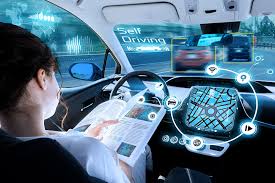
Imagine sitting in your car, but instead of gripping the steering wheel, you’re sipping coffee ☕, reading your emails 📧, or even taking a quick nap 😴. That’s the world self-driving cars are aiming to create.
🤔 What exactly are self-driving cars?
Self-driving cars (or autonomous vehicles) are cars that can drive themselves without human input. They use a mix of:
-
Sensors (like radar, lidar, and ultrasonic sensors) 👀 to “see” the road.
-
Cameras 🎥 to recognize things like traffic lights, pedestrians, and signs.
-
AI + algorithms 🧠 to make decisions: when to brake, when to accelerate, how to change lanes.
-
GPS + maps 🗺️ to know where they are and where they’re going.
Basically, it’s like giving your car a brain, eyes, and reflexes.
🛣️ The Levels of Autonomy
Not all “self-driving” cars are the same. The industry uses 6 levels (0–5) to describe autonomy:
-
Level 0 → Old-school driving. You do everything. 🚦
-
Level 1 → Some assistance, like cruise control.
-
Level 2 → Partial automation (think Tesla Autopilot). The car can steer + accelerate, but you must watch carefully.
-
Level 3 → Conditional automation. The car handles driving, but you may need to take over in tricky spots.
-
Level 4 → High automation. The car can drive itself in most situations, no human needed (but still has a steering wheel).
-
Level 5 → Full automation. No steering wheel, no pedals — just sit back and relax. 🛋️
Right now, most cars are around Level 2–3.
🧑💻 How Do They “Think”?
A self-driving car is like a gamer playing a super intense video game — but in real life.
-
Perception → The car collects data from sensors & cameras. (“That’s a red light. That’s a cyclist.”)
-
Prediction → It guesses what’s going to happen. (“The cyclist might turn left. The car in front will likely slow down.”)
-
Decision → It decides what to do. (“I should brake lightly now.”)
-
Action → The car actually steers, brakes, or accelerates.
All of this happens in milliseconds ⚡ thanks to Edge AI and powerful onboard computers.
🌟 Benefits of Self-Driving Cars
-
Safety 🛡️: 90% of accidents are caused by human error. Cars don’t get drunk, sleepy, or distracted.
-
Convenience 🛋️: Commutes become chill time.
-
Accessibility ♿: Elderly or disabled people could travel freely.
-
Efficiency 🌍: Cars could communicate with each other to reduce traffic jams and save fuel.
⚠️ Challenges (It’s Not Perfect Yet)
-
Edge cases 🧩: What if a deer jumps out of nowhere? Or there’s unexpected construction?
-
Ethical dilemmas 🤔: In a split-second crash situation, who should the car prioritize saving?
-
Hacking/security 🔒: If it’s a computer, it can be hacked.
-
Legal stuff ⚖️: Who’s responsible if a self-driving car causes an accident — the driver, the company, or the AI?
🚀 The Road Ahead
Big players like Tesla, Waymo, Apple, and Uber are racing to make fully autonomous cars mainstream. Right now, some cities in the US already have robotaxi services — cars with no drivers at all!
But worldwide? We’re probably still a few years away from everyday use.
✨ In short: Self-driving cars aren’t just a sci-fi dream anymore. They’re computers on wheels that could make our roads safer, our commutes easier, and our cities smarter. The only question is: are we ready to hand over the steering wheel?